
Synthesis of Highly Functionalized 2-Pyranone from Silyl Ketene.

Synthesis of Highly Functionalized 2-Pyranone from Silyl Ketene.

We report a extremely functionalized 2-pyranone small molecule ready from tert-butyl diphenyl silyl ketene utilizing an alkoxide catalyst and thermally induced rearrangement.

Treatment of the silyl ketene with a substoichiometric quantity of alkoxide led to the formation of a trimer which was remoted and totally characterised; heating this trimer in a 1,4-dioxane resolution induced a thermal rearrangement, yielding the product 2-pyranone.

The remoted intermediate and product are characterised by 1D and 2D nuclear magnetic resonance (NMR) spectroscopies, mass spectrometry, and single crystal X-ray diffraction. A mechanism for the thermally induced rearrangement is proposed based mostly on 1H NMR research, and a price legislation is derived from the proposed mechanism with steady-state approximation. This work illustrates a route for the formation of extremely functionalized and modifiable 2-pyranone motifs with potential organic exercise.

The formation of the trimer, and thus the functionalized 2-pyranone, is very depending on the silyl substituents and alkoxide counterion and thus signifies the intriguing reactivity of extremely functionalized small molecules.

Synthesis of Highly Functionalized 2-Pyranone from Silyl Ketene.

Synthesis, vibrational spectroscopy and X-ray structural characterization of novel NIR emitter squaramides.

Two new 2-naphthyl squaramides, 3-methoxy -4-(2-naphtalenylamino)-3-cyclobutene-1,2-dione (SQ-NPh1) and bis-3,4-(2-naphtalenylamino)-3-cyclobutene-1,2-dione (SQ-NPh2) had been synthesized by way of condensation response between the dimethylsquarate and 2-naphthylamine.

The spectrometric characterization by 13C NMR confirmed the acquiring of the squaramide spinoff and nor the squaraine analog. This speculation was corroborated by Raman and Infrared spectroscopy for the reason that attribute vibrational bands associated to the oxocarbon portion of each constructions have been assigned, resembling those for SQ-NPh1 and SQ-NPh2.

The singlecrystal X-ray crystallography for SQ-NPh1 crystal constructions have been solved and the construction of SQ-NPh2 have been refined utilizing Powder Diffraction state-of-art. The SQ-NPh1 crystallizes in monoclinic system in P2/c house group.

Both squaramides current absorption within the ultra-visible (220-370 nm) and fluorescent emission within the near-infrared (780-800 nm), apart from in addition they offered excessive thermal stability (round 570 °C). Generally, solely squaraines are reported as NIR emitters, that is the primary description of NIR emission for squaramides, and for the reason that synthesis of squaramides could be very simple and the rational design of smallmolecule NIR fluorophores is of excessive precedence and nice worth, these outcomes are very promising for the event of novel NIR fluorescent dyes.
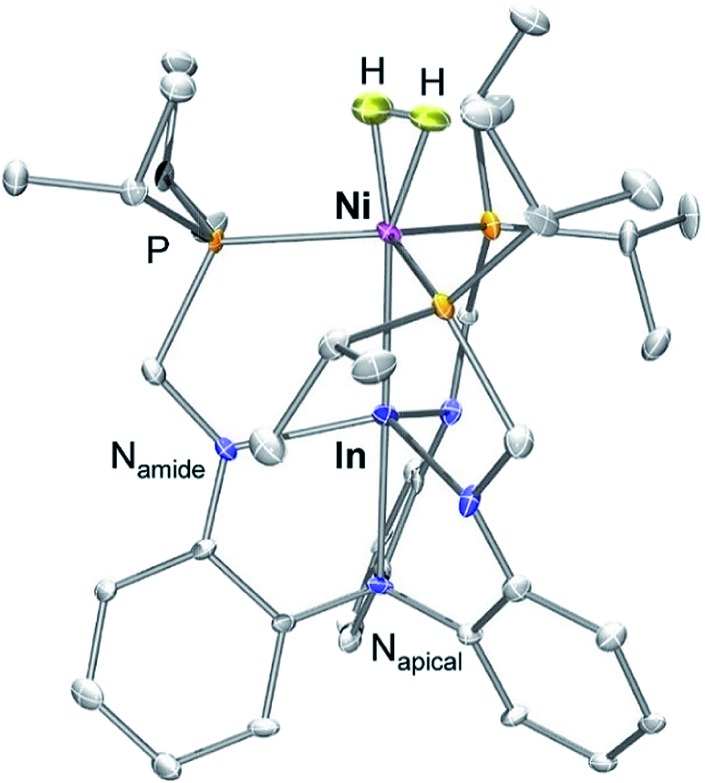
Thermodynamic and kinetic studies of H2 and N2 binding to bimetallic nickel-group 13 complexes and neutron structure of a Ni(η2-H2) adduct.

Thermodynamic and kinetic studies of H2 and N2 binding to bimetallic nickel-group 13 complexes and neutron structure of a Ni(η2-H2) adduct.

Understanding H2 binding and activation is vital within the context of designing transition metallic catalysts for a lot of processes, together with hydrogenation and the interconversion of H2 with protons and electrons.

This work experiences the primary thermodynamic and kinetic H2 binding studies for an isostructural collection of first-row metallic complexes: NiML, the place M = Al (1), Ga (2), and In (3), and L = [N(o-(NCH2PiPr2)C6H4)3]3-.

Thermodynamic free energies (ΔG°) and free energies of activation (ΔG) for binding equilibria have been obtained by way of variable-temperature 31P NMR studies and lineshape evaluation.

The supporting metallic exerts a massive affect on the thermodynamic favorability of each H2 and N2 binding to Ni, with ΔG° values for H2 binding discovered to span almost the complete vary of earlier experiences. The non-classical H2 adduct, (η2-H2)NiInL (3-H2), was structurally characterised by singlecrystal neutron diffraction-the first such examine for a Ni(η2-H2) complicated or any d10 M(η2-H2) complicated.

UV-Vis studies and TD-DFT calculations recognized particular digital structure perturbations of the supporting metallic which poise NiML complexes for smallmolecule binding. ETS-NOCV calculations point out that H2 binding primarily happens by way of H-H σ-donation to the Ni 4p z -based LUMO, which is proposed to develop into energetically accessible because the Ni(0)→M(iii) dative interplay will increase for the bigger M(iii) ions.

Linear free-energy relationships are mentioned, with the activation barrier for H2 binding (ΔG) discovered to lower proportionally for extra thermodynamically favorable equilibria. The ΔG° values for H2 and N2 binding to NiML complexes have been additionally discovered to be extra exergonic for the bigger M(iii) ions.

Thermodynamic and kinetic studies of H2 and N2 binding to bimetallic nickel-group 13 complexes and neutron structure of a Ni(η2-H2) adduct.

Building Blocks for High-Efficiency Organic Photovoltaics. Interplay of Molecular, Crystal, and Electronic Properties of Post-Fullerene ITIC Ensembles.

Accurate singlecrystal x-ray diffraction knowledge provide a distinctive alternative to evaluate and distinction the atomistic particulars of bulk heterojunction photovoltaic smallmolecule acceptor structure and packing, in addition to present a necessary start line for computational digital structure and cost transport evaluation.

Here we report diffraction-derived crystal constructions and computational analyses on ITIC and seven derivatives (together with three new crystal constructions: ITIC-C3, m-ITIC-C6, and ITIC-C4-4F. IDTT acceptors sometimes pack in a face-to-face style with π-π distances starting from 3.28-3.95 Å. Additionally, edge-to-face packing is noticed with S⋯π interactions as quick as 3.21-3.24 Å.

ITIC finish group identities and aspect chain substituents affect the character and power of noncovalent interactions (e.g. H-bonding, π-π) and correlate with the noticed packing motif, digital structure, and cost transport properties of the crystals. Density useful principle (DFT) calculations reveal comparatively massive nearest-neighbor intermolecular π-π digital couplings (5.85-56.eight meV) and correlate the character of the band structure with the dispersion interactions within the single crystals and core-end group polarization results.

This mixed experimental and theoretical work reveals key insights into crystal engineering methods for indacenodithienothiophene (IDTT) acceptors, in addition to normal design guidelines for natural photo voltaic cell post-fullerene small molecule acceptors.

Simultaneous Enhancement of Near-Infrared Emission and Dye Photodegradation in a Racemic Aspartic Acid Compound via Metal-Ion Modification.

Simultaneous Enhancement of Near-Infrared Emission and Dye Photodegradation in a Racemic Aspartic Acid Compound via Metal-Ion Modification.

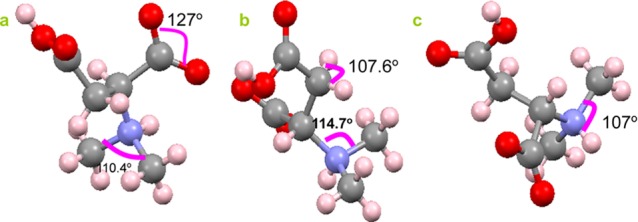
Changing functionalities of materials using simple methods is an active area of research, as it is “green” and lowers the developing cost of new products for the enterprises. A new small molecule racemic N,N-dimethyl aspartic acid has been prepared.

Its structure is determined by singlecrystal X-ray diffraction. It is characterized by FTIR, XPS, 1H NMR, and mass spectroscopy. Its near-infrared luminescence can be enhanced by the combination of metal ions, including Dy3+, Gd3+, Nd3+, Er3+, Sr3+, Y3+, Zn2+, Zr4+, Ho3+, Yb3+, La3+, Pr6+/Pr3+, and Sm3+ ions.

An optical chemistry mechanism upon interaction between the sensitizer and activator is proposed. Furthermore, the association of Ca2+, Sr2+, or Zr4+ ions to the molecule enhanced its photodegradation for dyes under white-light irradiation.

Specifically, rhodamine 6G can be degraded by the Ca2+-modified molecule; rhodamine B, rhodamine 6G, and fluorescein sodium salt can be degraded by the Sr2+– or Zr4+-modified molecule. This surprising development opens a way in simultaneously increasing NIR luminescence and the ability of dye photodegradation for the investigated molecule.

Simultaneous Enhancement of Near-Infrared Emission and Dye Photodegradation in a Racemic Aspartic Acid Compound via Metal-Ion Modification.

Absolute structure of the chiral pyrrolidine derivative (2S)-methyl (Z)-5-(2-tert-butoxy-1-cyano-2-oxoethylidene)pyrrolidine-2-carboxylate, a compound with low resonant scattering.

The enantiopure monopyrrolidine derivative (2S)-methyl (Z)-5-(2-tert-butoxy-1-cyano-2-oxoethylidene)pyrrolidine-2-carboxylate, C13H18N2O4, (1), represents a potential ligand and an attractive intermediate for the synthesis of chiral metal complexes. At the molecular level, the compound features an intramolecular N-H…O hydrogen bond; neighbouring molecules interact via N-H…N contacts to form chains along [100].

Due to its elemental composition, resonant scattering of the target compound is entirely insignificant for diffraction experiments with Mo Kα and small even for Cu Kα radiation. A preliminary study with the harder radiation type confirmed the chiral space group and the suitability of the single crystal chosen; as expected, the results concerning the absolute structure remained completely inconclusive. A second data collection with the longer wavelength gave satisfactory quality indicators for the correct handedness of the molecule, albeit with high standard uncertainties.

The absolute configuration has been assessed independently: CD spectra for both enantiomers of the target molecule were calculated and the spectrum for the S-configured stereoisomer was in agreement with the experiment. The Cotton effect of (1) may be ascribed to π-π* transitions from HOMO to LUMO and from HOMO to LUMO+1. As both independent techniques agree with respect to the handedness of the target molecule, the absolute structure may be assigned with a high degree of confidence.